

If you are opening a medical or dental practice in Sydney, the fit-out process is more complex than for a standard commercial project. This guide walks you through every stage, from feasibility to opening day, with a focus on the healthcare compliance checkpoints that most fitout guides skip entirely. Whether you are planning a medical centre fitout or a dental surgery fitout, this step-by-step framework will help you before you commit to a lease, a builder, or a timeline.
Why a Medical Fitout Is Not a Standard Commercial Fitout
Healthcare fitouts operate under a completely separate set of building codes, infection control standards, and council requirements that standard office fitouts never encounter. Understanding this distinction before you start will save you months of delays and tens of thousands in rework.
Under the Building Code of Australia (BCA), a medical or dental practice is classified as Class 9a, which applies to healthcare premises. A typical office is Class 5. That single classification change affects everything from fire safety and ventilation rates to accessibility provisions and construction standards. The requirements are significantly stricter.
On top of the BCA, Infection Prevention and Control (IPC) standards in NSW dictate the material finishes you can use in clinical areas, the ventilation rates required, and how spaces must be physically separated. These are not optional design preferences. There are regulatory requirements that will be inspected.
Then there are council requirements. When premises are converted to medical or dental use, your local council's Development Application (DA) conditions change. Parking ratios increase. Waste management plans become mandatory. Accessibility requirements expand. Getting any of these wrong can prevent you from practising altogether, so the stakes are real from the very first decision you make.
To help clarify the key differences between a medical fitout and a standard commercial fitout, here's a quick comparison table.
Medical Fitout vs Commercial Fitout
| Feature | Medical Fitout | Commercial Fitout |
|---|---|---|
| BCA Class | Class 9a (Healthcare premises) | Class 5 (Office spaces) |
| Ventilation Requirements | Higher air change rates, infection control | Standard air circulation |
| Council Approvals | Development Application (DA) required for change of use, additional documentation (e.g., waste management, parking) | May not require DA for minor modifications |
| Specialist Trades | Medical gas installation, sterilisation equipment, radiation shielding, HVAC with infection control | General construction and office-specific trades |
| Typical Timeline | 5-9 months, including approvals and specialist work | 2-4 months, generally simpler scope |
Step 1: Feasibility and Site Assessment
Before you sign a lease or commit to a purchase, you need to know whether your chosen premises can physically and legally support a medical or dental practice. A feasibility assessment answers that question.
Key feasibility factors include:
- Zoning and permitted use under the local council's planning controls
- Existing building classification and whether a Change of Use DA is required
- Structural capacity for heavy equipment such as dental chairs, imaging units, or lead-lined radiology rooms
- Access to essential services like medical gas, three-phase power, and an adequate water supply
- Accessibility compliance for patients with disabilities
Structural assessments may also be needed if you are installing heavy dental chairs or imaging equipment. These are not things you want to discover after you have signed a lease.
Working with a team that coordinates multiple trades under one project manager means your feasibility assessment covers all disciplines from day one, including mechanical, electrical, hydraulic, and structural. Get a free site assessment for your medical fitout before you commit to anything.
Get a free site assessment for your medical fitout before you commit to anything.
Step 2: Design and Compliance Planning
Design for a healthcare fitout is driven first by regulatory requirements, then by aesthetics. This section covers the compliance frameworks that shape every design decision for a medical or dental practice fitout.
Three frameworks do the heavy lifting:
- BCA Class 9a sets the construction standards for fire safety, ventilation, accessibility, and structural requirements specific to healthcare premises.
- The Australian Health Facility Guidelines (AHFG) dictate minimum room sizes, clinical zone separation, and natural light requirements for patient areas.
- WHS regulations for healthcare environments cover sharps disposal access, manual handling provisions, and emergency egress from clinical rooms.
Clinical workflow must align with infection control zoning to ensure clean and dirty areas are separated, a key compliance consideration when designing a healthcare fitout. Waiting areas, consulting rooms, treatment rooms, and sterilisation areas each have specific spatial and ventilation requirements under AHFG compliance.
To help you visualise how these compliance frameworks intersect during the design phase, here's a diagram illustrating their overlapping requirements.
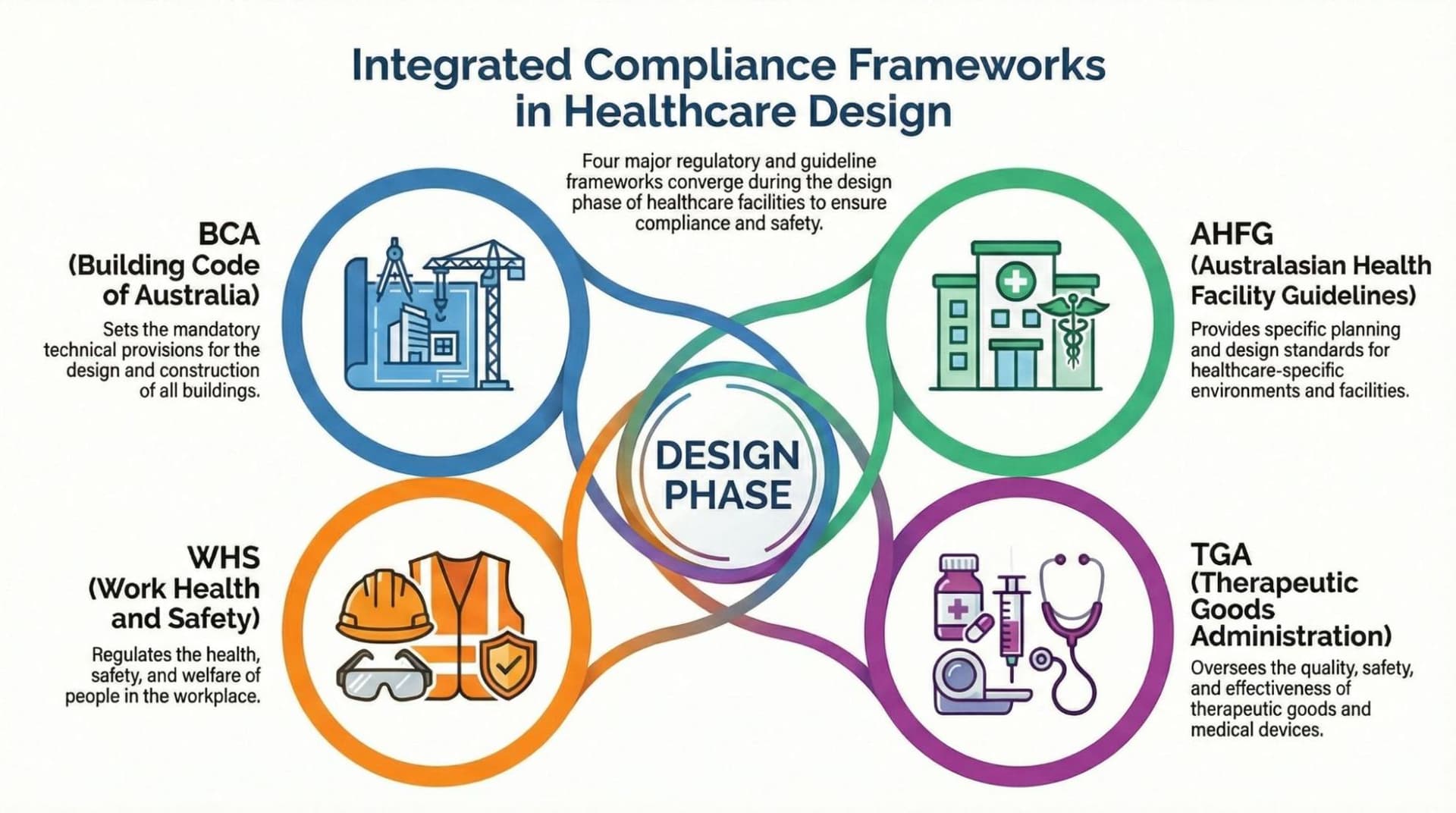
Therapeutic Goods Administration (TGA) requirements may also apply to certain built-in equipment and sterilisation infrastructure. If your practice includes imaging, the design must account for radiation shielding from the outset.
Step 3: Council Approvals and Documentation
Council approvals are the stage that most first-time practice owners are caught off guard by. Here is what you need to know about the DA process for medical and dental use in Sydney.
A Development Application is typically required when you change the use of premises to medical or dental. This is triggered by the change in BCA classification to Class 9a, and by the council's own planning controls. Key documentation for DA approval typically includes architectural plans, accessibility reports, and waste management plans.
A Construction Certificate is a separate requirement. It must be issued before any physical work begins on a Class 9a fitout. The CC confirms that the proposed construction complies with the BCA and relevant Australian Standards.
Common DA pitfalls include:
- Insufficient parking provision for the expected patient volume
- Missing or inadequate waste management plans for clinical waste
- Incomplete accessibility reports
- Failing to address council-specific requirements early
DA approval timeframes in Sydney councils typically range from 8 to 16 weeks, depending on the council and the complexity of the application. Local council approval expertise matters here.
Knowing what each council expects, particularly across Greater Western Sydney and the broader Sydney metro, reduces the risk of requests for additional information that push your timeline out further.
Step 4: Specialist Trades and What Makes Healthcare Fitouts Complex
A medical or dental fitout requires specialist trades that most standard commercial builders do not have on their books. Using the wrong trades is one of the fastest ways to fail an inspection and trigger costly rework.
Key specialist trades for a healthcare fitout Sydney project include:
- Medical gas installation, which requires specific trade licensing in NSW
- Sterilisation equipment plumbing with compliant drainage and water supply
- Radiation shielding for dental X-ray rooms, which must meet state radiation safety requirements
- HVAC systems with infection control filtration and compliant air change rates
- Clinical-grade electrical work for equipment circuits and emergency power
The risk of using non-specialist trades is straightforward. Failed inspections mean rework. Rework means delays and additional costs. Compliance gaps discovered after handover can prevent you from opening or passing an audit.
Multi-trade coordination under one project manager ensures specialist trades are scheduled in the correct sequence and inspected at each stage. When medical gas, hydraulics, electrical, and mechanical trades are managed independently, clashes and delays are almost guaranteed.
Planning a Dental Fitout: Additional Requirements
A dental fitout project in Sydney has infrastructure requirements that go well beyond those of a standard medical practice. This section covers what makes a dental surgery fitout unique.
Each dental chair requires dedicated plumbing for water supply, suction, compressed air, and waste lines. Multiply that by the number of surgeries you are fitting out, and the hydraulic complexity becomes significant. Surgery layouts must also provide adequate access for operators and assistants on both sides of the chair, with clear circulation space for emergency situations.
Supporting infrastructure includes:
- Compressor and suction pump rooms with dedicated ventilation and noise isolation
- High-volume water supply to serve multiple chairs simultaneously
- Amalgam separators compliant with trade waste requirements
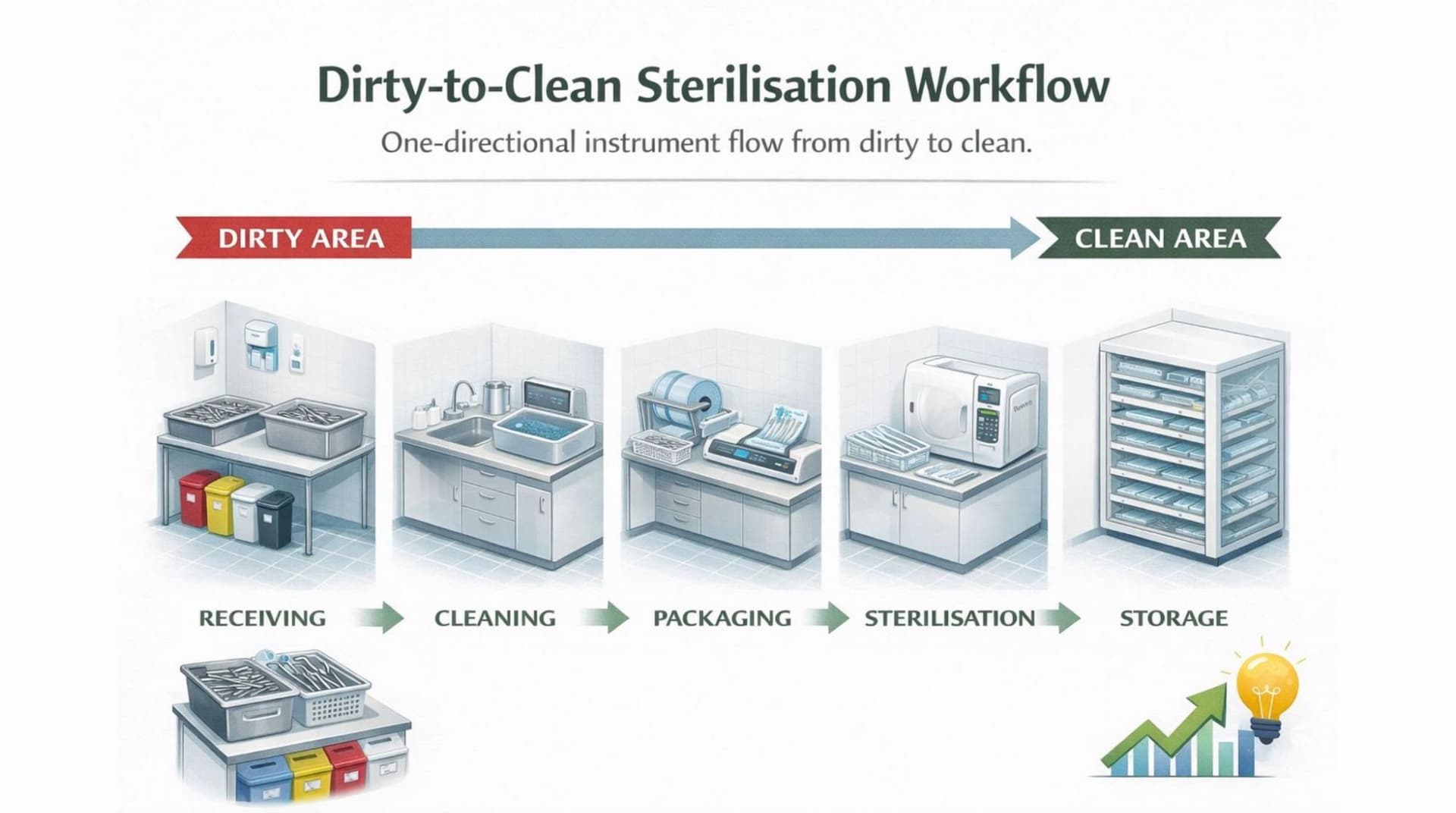
- Sterilisation rooms designed with clear dirty-to-clean workflow separation, meeting IPC standards
The sterilisation area is a compliance-critical space. Instruments must flow in one direction, from dirty to clean, with no risk of cross-contamination. Material finishes must be impervious, seamless where possible, and easy to decontaminate.
To help you visualise the ideal workflow for sterilisation in your dental practice, here's a clear, one-way flowchart that outlines each stage from receiving to storage.
Our completed fitout for Verani Dentist in Bella Vista demonstrates how these requirements were addressed from the design phase, including compliant surgical layouts, sterilisation workflows, and supporting mechanical and hydraulic infrastructure.
See how we planned this dental fitout - the Verani Dentist project shows what a compliant dental surgery fitout looks like from design through to completion.
Step 5: Construction, Fitout, and Keeping Your Practice Running
The fitout phase follows demolition, structural work, rough-in of services, and fixture installation, with progressive inspections to verify compliance.
If your practice needs to keep operating during the fitout, staging becomes critical. This might mean completing the work in zones, with temporary walls and dust barriers separating the construction area from active clinical spaces. After-hours and weekend work can also reduce disruption to patients and staff.
Fixed-price quotes with no hidden surprises allow practice owners to plan cash flow during construction, which matters when you are managing a business and a building project simultaneously.
Our ENT Institute Norwest project is a good example of coordinated multi-trade delivery for a medical fitout, where careful staging and scheduling kept the project on track without compromising compliance at any stage.
Step 6: Handover, Compliance Certificates, and Opening Day
A proper handover for a medical fitout is not just handing over the keys. It is a documented process that underpins your registration, insurance, and future compliance audits.
Handover documentation for a Class 9a fitout includes:
- Compliance certificates for all building work
- Fire safety statements and essential services certificates
- Mechanical ventilation certificates confirming compliant air change rates
- Equipment warranties for all installed healthcare systems
- O&M manuals for medical gas, sterilisation equipment, HVAC filtration, and other healthcare-specific systems
An Occupation Certificate must be issued before the practice can legally open to patients. This confirms the completed work meets the BCA and the conditions of the Construction Certificate.
Build a two-week buffer before your planned opening date. Final inspections, defect rectification, and equipment commissioning always take longer than expected. That buffer is the difference between a smooth opening and a stressful one.
How Long Does a Medical Fitout Take in Sydney?
A realistic planning timeline for a medical or dental fitout in Sydney breaks down into four phases:
- Feasibility and design: 4 to 6 weeks
- Council approvals (DA and CC): 8 to 16 weeks
- Construction: 8 to 16 weeks, depending on scope
- Handover and commissioning: 1 to 2 weeks
To give you a clearer understanding of the fitout process, here's a visual timeline outlining each phase and the estimated timeframes.
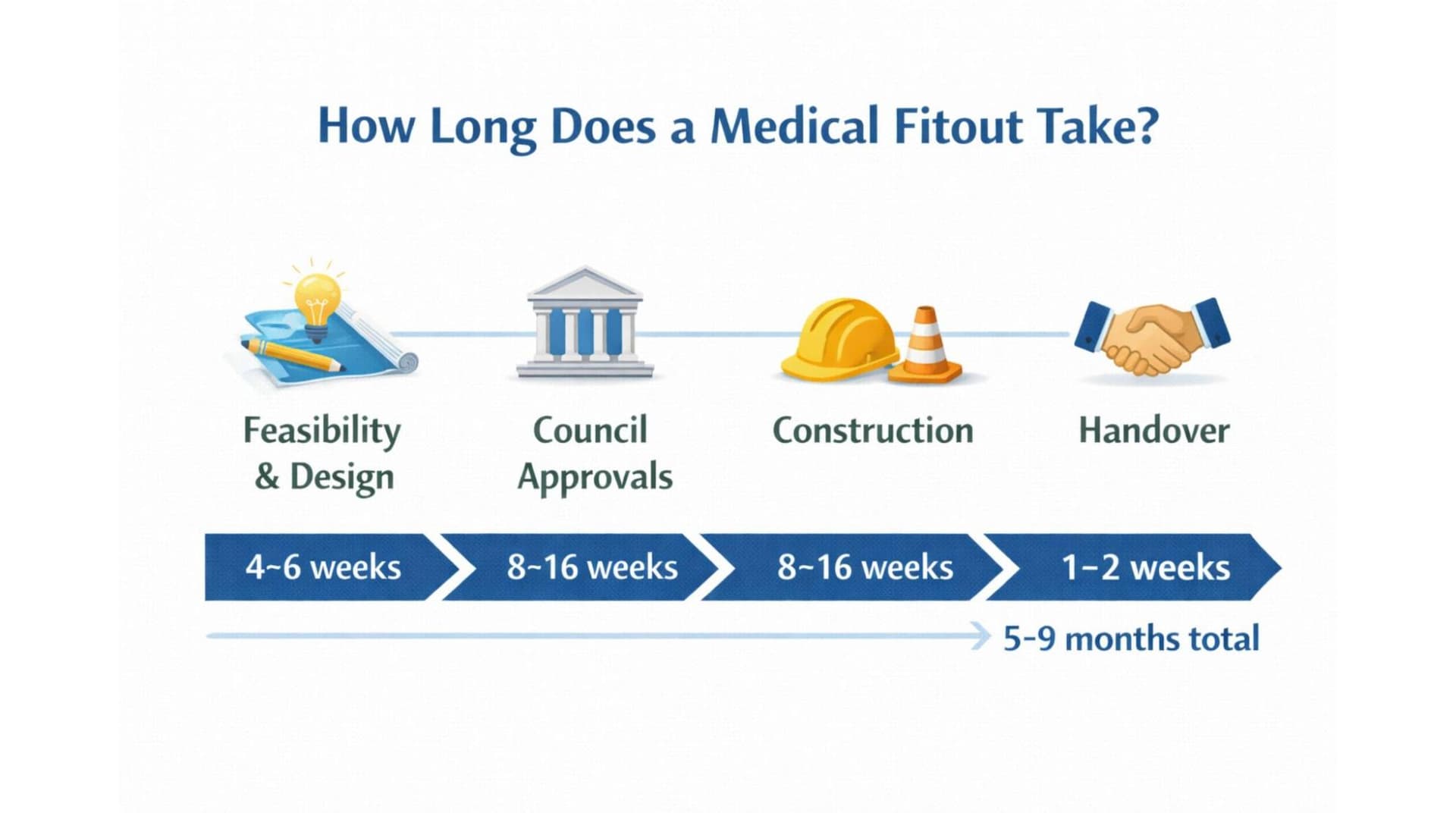
For a mid-size medical practice fitout of 200 to 400 square metres, the total timeline from first meeting to patient-ready handover is typically 5 to 9 months.
The most common causes of delay are late DA submissions, design changes made after approvals are granted, and using builders without medical fitout experience who underestimate the compliance requirements.
When planning your budget alongside this timeline, understanding commercial fitout costs in Sydney will help you set realistic expectations for both time and investment.
Choosing a Fitout Company with Medical Experience
Not every commercial fitout company is equipped to deliver a healthcare fitout. Here is what to look for when evaluating your options.
Your checklist:
- Proven project history in medical and dental fitouts, not just general commercial work
- Demonstrated understanding of BCA Class 9a requirements
- Established relationships with specialist trades, including medical gas, sterilisation, plumbing, and radiation shielding
- Local council approval experience, particularly across the councils you will be dealing with
- A single project manager who coordinates every discipline from feasibility through to handover
- Fixed-price quotes so you know exactly what you are paying before work begins
A general commercial fitout company that treats a medical practice fitout as just another office job will cost you time and money in compliance gaps and rework. The complexity of healthcare fitouts demands a team that has done it before and understands what inspectors and regulators expect.
If you are comparing fitout companies, explore our medical fitout services to see how we approach healthcare projects from feasibility to handover.
Book a free site assessment - before you commit to a lease or a builder, find out whether your premises can support the practice you are planning.
Frequently Asked Questions About Medical Fitouts in Sydney
What BCA class applies to a medical practice?
Medical and dental practices are classified as Class 9a under the BCA, imposing stricter standards for fire safety, ventilation, and accessibility compared to standard office spaces.
Do I need a DA to convert an office to a dental surgery?
Yes, a DA is generally required to convert office spaces to medical or dental use.
How much does a medical fitout cost per square metre in Sydney?
Costs for medical fitouts in Sydney vary significantly based on factors such as the number of treatment rooms, the complexity of imaging requirements, and the level of sterilisation infrastructure required. For a more accurate estimate based on your specific needs, contact us for a fixed-price quote.
Can I keep my practice open during the fitout?
Yes, with careful staging. The fitout can be delivered in zones with temporary barriers separating construction from active clinical areas. After-hours and weekend work can further reduce disruption to your patients and staff.
What compliance certificates do I need before opening?
You will need an Occupation Certificate, compliance certificates for all building work, fire safety statements, mechanical ventilation certificates, and equipment warranties. Without these, your practice cannot legally open to patients or satisfy registration and insurance requirements.
Talk to our team about your medical fitout - whether you are in the early planning stages or ready to start, we can walk you through what is involved for your specific practice.