
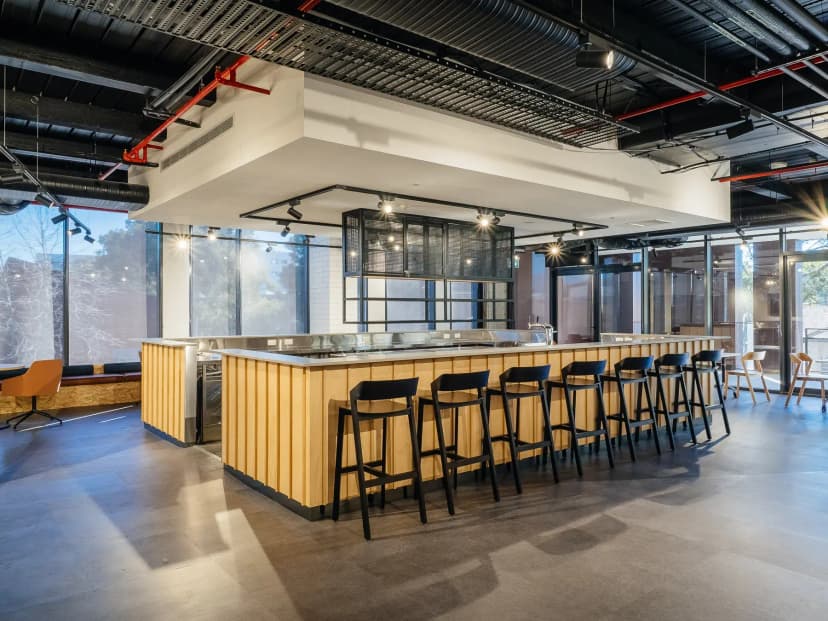
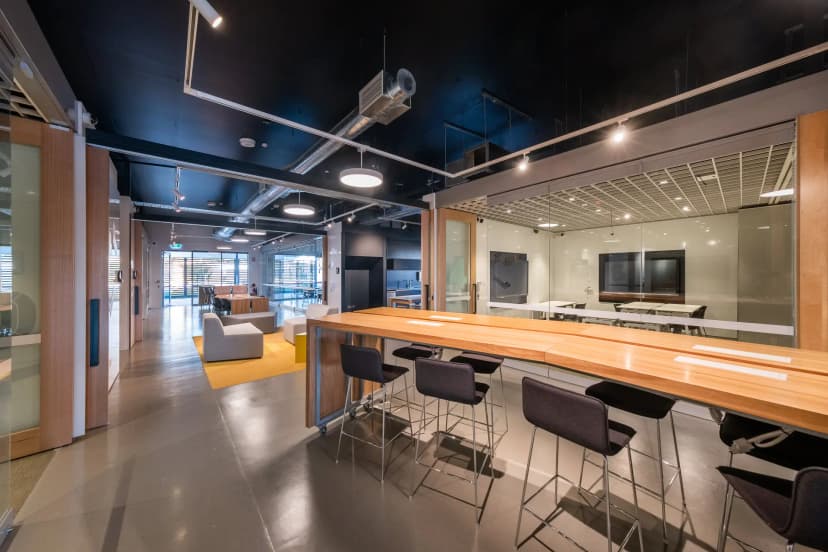
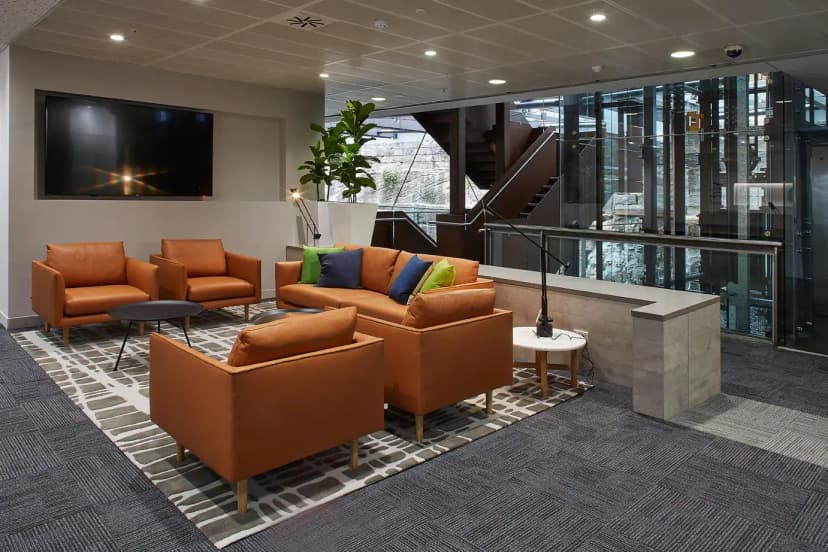

A warehouse office fitout involves transforming a portion of an existing industrial warehouse into dedicated office space. This can either be a mezzanine-level structure or a ground-level partitioned area, all while ensuring compliance with the Building Code of Australia (BCA) requirements for mixed-use classifications.
At Stemar Group, we specialise in delivering tailored warehouse office fitouts with a focus on efficiency, compliance, and seamless integration with your operations.
Your Warehouse Is Growing, and Your Office Setup Needs to Catch Up
If your admin team is working from a partitioned corner with a bar fridge and a portable building out the back doubles as your meeting room, you are not alone. Across the Western Sydney corridor, logistics and warehousing businesses are scaling fast. More staff, more clients walking through the door, tighter compliance requirements.
The problem is clear: you need proper office space, but you cannot afford to shut down warehouse operations to build it. Forklifts still need to move. Orders still need to ship. Revenue cannot stop while someone frames up a wall.
This guide covers the key decisions involved in a warehouse office fitout, from choosing between a mezzanine and ground-level office through to council approvals, compliance, realistic costs, and how to keep your facility running during construction.
Mezzanine Office or Ground-Level Partition: How to Decide
There are two main approaches. A mezzanine office sits on a steel platform structure elevated above the warehouse floor. A ground-level partitioned office is a walled-off section at floor level. Both work. The right choice depends on your building and your operations.
Here are the four criteria that drive the decision:
- Ceiling height. Mezzanine offices typically require a clear height of at least 6 meters, with most warehouses in Western Sydney averaging 7 to 12 meters in clear height. A 7m height provides optimal flexibility for creating a usable mezzanine space.
- Floor loading capacity. The existing concrete slab must support the additional weight of the mezzanine structure, which can range from 500 to 1,500 kg per square meter depending on the design. A structural assessment is critical to determine your warehouse's load-bearing capacity.
- Access requirements. Stairs are standard. If you have staff or visitors with mobility requirements, DDA-compliant lift access adds cost and planning time.
- Cost. Mezzanine office fitouts in Sydney typically cost between $800 and $1,500 per square meter, with the variation depending on design complexity and materials. Ground-level office fitouts range from $600 to $1,200 per square meter. For example, a 100-square-meter ground-level fitout can cost anywhere from $60,000 to $120,000.
The trade-off is straightforward. A mezzanine preserves valuable floor space for racking and operations, but costs more upfront. Ground-level is simpler and faster, but it eats directly into your warehouse footprint.
To help you make an informed decision, here's a side-by-side comparison of the key factors to consider when choosing between a mezzanine and ground-level office for your warehouse fitout.
Mezzanine vs Ground-Level Office Comparison
| Criteria | Mezzanine Office | Ground-Level Office |
|---|---|---|
| Ceiling Height | Requires at least 6m clear height for structural feasibility | No height requirements, built at floor level |
| Floor Loading Capacity | Requires a structural assessment to support additional load | No special loading capacity needed |
| Access | Typically accessed via stairs, an optional DDA-compliant lift | Easily accessible, no special access requirements |
| Cost | Typically $800 - $1,500 per sqm, higher due to structural work | Generally $600 - $1,200 per sqm, more affordable |
For most growing operations where floor space equals revenue, the mezzanine pays for itself.
Solving the Practical Challenges: Noise, Dust, and Climate Control
An office next to forklift operations, pallet wrapping machines, and loading dock activity needs serious separation. This is not just about comfort. Under Safe Work Australia guidelines, managing noise exposure for office workers in industrial environments is a WHS obligation.
For effective acoustic separation, walls and ceilings should have an STC (Sound Transmission Class) rating of at least 50. This rating ensures adequate noise isolation, particularly in areas where forklift operations and loading docks generate significant noise (typically 80-100 decibels). Double-glazed windows if the office overlooks the warehouse floor. Solid-core doors, not hollow-core.
Dust is the other persistent issue. Sealed wall-to-ceiling junctions prevent particle ingress. Positive air pressure in the office area pushes air out rather than drawing warehouse dust in. Your HVAC system needs filtration rated for an industrial environment, not a standard commercial office.
Climate control must be independently zoned. Your warehouse is likely unconditioned or minimally heated. The office needs its own HVAC system, with insulated walls and a ceiling, to manage thermal differences. The National Construction Code requires fire-rated separation between Class 5 office and Class 7b warehouse areas, and that the rated construction also improves thermal and acoustic performance.
Power, Data, and Infrastructure You Cannot Afford to Skip
The existing switchboard is typically sized for warehouse equipment like high-bay lighting, roller doors, and industrial compressors, which often consume between 5 to 30 kW of power. Upgrading the board for office requirements (e.g., HVAC, IT) may necessitate an increase in available power capacity to 50 kW or more.
For data and communications, invest in structured cabling from day one. Steel warehouse structures significantly weaken wireless signals, so relying on Wi-Fi alone is a mistake. Plan your comms rack or server room location, map out access point positions, and confirm NBN or fibre connectivity reaches the office area.
Lighting is a compliance point people miss. Under AS/NZS 1680, general office tasks require a minimum of 320 lux, compared to the 160 lux typical in warehouse storage areas. Your office lighting design must meet this standard independently of the warehouse's high-bay system.
Amenities, Break Rooms, and Meeting Spaces
Adding office workers to your existing warehouse headcount may trigger additional amenities requirements. The Safe Work Australia Model Code of Practice for Managing the Work Environment and Facilities specifies minimum toilet and washroom facilities based on the total number of workers. Check your current provision against the updated headcount before you finalise the fitout scope.
Under the Safe Work Australia guidelines, workplace amenities must include a kitchen or break room when there are more than 20 employees on-site. A kitchen area should be equipped with basic facilities such as a refrigerator, microwave, and seating for 4-6 staff members. It makes practical sense to co-locate these with the office area. If your warehouse staff currently lack proper break facilities, this is an opportunity to bring everything up to current standards in one project. That is a compliance benefit, not just a nice-to-have.
Even one properly fitted meeting room changes how you deal with clients, suppliers, and compliance audits. Acoustic privacy matters here. A glass-walled room overlooking a noisy warehouse floor without proper glazing defeats the purpose. Include presentation technology and decent lighting, and you have a space that works for everything from sales meetings to safety briefings.
Keeping Your Warehouse Running During Construction
This is the part that keeps warehouse operators up at night. Construction in an active facility entails safety risks, workflow disruptions, and the potential loss of revenue. It does not have to work that way.
A staged delivery approach isolates construction work zones from active warehouse areas using temporary hoarding and dust barriers. Material deliveries are coordinated to avoid clashing with your warehouse logistics schedule. Your operations keep moving in parallel.
Noisy, disruptive trades are scheduled outside your operating hours. Concrete cutting, steel installation, and heavy structural work occur when the warehouse is quiet, whether after hours, on weekends, or between shifts. A single project manager coordinating all trades ensures the sequencing works and nothing falls through the gaps.
Safety management is non-negotiable. Separate access paths for construction workers and warehouse staff. Clear signage throughout. Site inductions for every trade working in your active facility. This is standard practice for warehouse fitout solutions delivered in operational environments.
Council Approvals and BCA Compliance for an Office in a Warehouse
Adding an office to an industrial-zoned warehouse may require a Development Application or a Complying Development Certificate, depending on the scale and your local council. Getting this wrong causes costly delays and rework, so sort it out before construction starts.
The core issue is a change of use. A warehouse is typically classified as Class 7b under the Building Code of Australia. An office is Class 5. Combining these in one building triggers specific requirements from the Australian Building Codes Board for fire-rated separation, egress paths, and accessibility provisions.
Each Western Sydney council has its own specific requirements for mixed-use industrial developments. Fairfield City Council, which covers the Smithfield-Wetherill Park Industrial Estate, has particular DCP provisions for industrial developments. Cumberland and Blacktown councils have their own processes. Local experience matters here because knowing what each council expects up front saves weeks of back-and-forth.
What to Expect on the Timeline and Cost
Realistic timeline ranges for warehouse office fitout projects:
- Small ground-level office (under 100sqm): 4 to 8 weeks construction
- Mezzanine office (100 to 300sqm): 8 to 14 weeks construction. However, a more complex fitout with custom design features may extend the timeline by 1 to 2 weeks.
- Larger or more complex projects: 12 to 20 weeks of construction
- Development Application (DA) approval: Add 4 to 8 weeks for council approvals before construction begins
Warehouse Office Fitout Timeline Ranges (Weeks)
If a DA is required, add 4 to 8 weeks for council approvals before construction begins.
Mid-market warehouse fitout projects in Sydney typically range from $80,000 to $350,000, depending on scope, size, and complexity. Costs climb with mezzanine structures, high-spec acoustic treatment, complex HVAC, and DDA-compliant access.
Example of Warehouse Office Fitout
A recent 200sqm mezzanine office fitout in Wetherill Park was completed in just 10 weeks while the warehouse maintained full operations. This project exemplifies how careful planning and staged construction can ensure minimal disruption to ongoing warehouse activities, while still meeting the necessary compliance and design requirements. It also demonstrates the typical cost and timeline expectations for similar projects in the region.
For a detailed breakdown, read our guide to commercial fitout costs in Sydney.
A fixed-price quote removes the uncertainty. You know the number before work starts, with no hidden surprises during construction.
Frequently Asked Questions
Do I need council approval for an office in a warehouse?
In most cases, yes. Adding an office to an industrial-zoned warehouse triggers a change of use from Class 7b to Class 5 under the Building Code of Australia. This may require a Development Application or Complying Development Certificate depending on the scale and your local council. Your contractor should advise on this during the quoting stage.
How much does a warehouse office fitout cost?
Mid-market warehouse fitout projects in Sydney typically range from $80,000 to $350,000. Mezzanine offices run $800 to $1,500 per square metre, while ground-level partitioned offices range from $600 to $1,200 per square metre depending on specifications and required services. For a detailed breakdown, see our commercial fitout cost guide.
How long does a warehouse office fitout take?
Small ground-level offices under 100sqm take 4 to 8 weeks. Mezzanine offices of 100 to 300sqm take 8 to 14 weeks. Larger or more complex projects take 12 to 20 weeks. Add 4 to 8 weeks if a Development Application is required.
Can I keep my warehouse running during the fitout?
Yes. A staged delivery approach isolates construction work zones from active warehouse areas. Noisy trades are scheduled outside operating hours, and a single project manager coordinates all trades to ensure your operations keep moving in parallel.
Next Step: Get a Site Assessment Before You Commit to Anything
Every warehouse is different. Ceiling height, structural capacity, existing services, access points, and council requirements all vary. Generic advice only gets you so far.
A site assessment determines what is actually feasible in your specific building and gives you a clear picture of scope, cost, and timeline before you commit to anything. Based in Wetherill Park, in the heart of Sydney's industrial heartland, we work with direct owner contact throughout the process.
Book a free site assessment and get clarity on your options. Explore our warehouse office fit-out services to see how they work.